


Crovetti Orthopaedics Launches URKnee™
Aligning Patient-Defined Outcomes and Rehabilitation Strategy for Knee Replacement
Dr. Michael Crovetti announces the launch of URKnee™, an innovative digital platform developed to bring greater precision, clarity, and coordination to every joint replacement performed at Crovetti Orthopaedics and Sports Medicine.
While joint replacement technology has advanced significantly, recovery communication has often remained fragmented. URKnee™ was created to close that gap for knee replacements — ensuring that surgical intent, patient expectations, and rehabilitation planning remain aligned from preoperative consultation through full recovery.
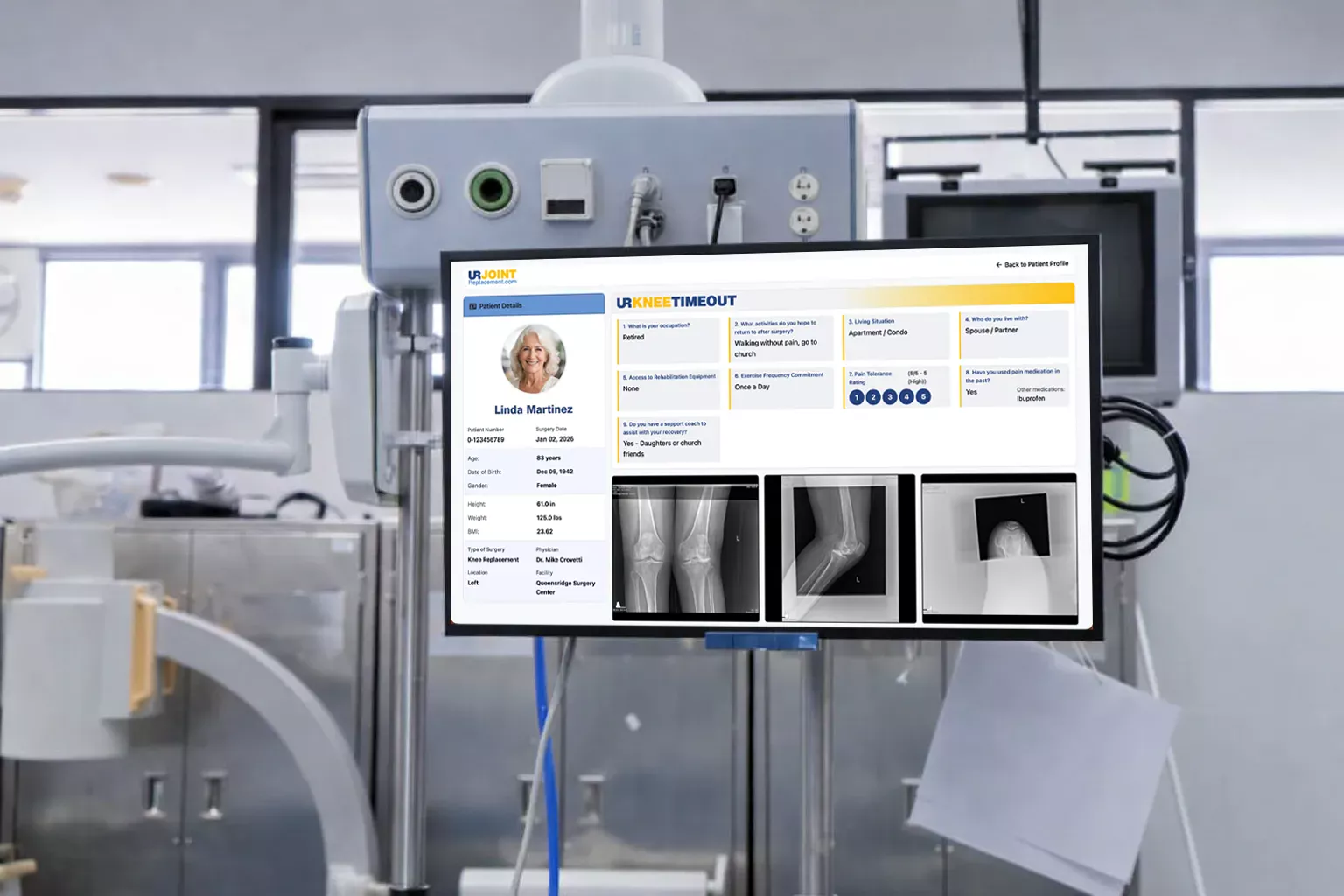
URKnee™ is an app that was developed by Crovetti Orthopaedics as part of the practice’s continued commitment to patient-centered innovation. Each patient receives a card with a link to their URKnee™ profile, which they can share with other physicians throughout their care.
“At Crovetti Orthopaedics, surgery doesn’t begin in the operating room — it begins with understanding what the patient wants life to look like afterward,” explains Dr. Crovetti.
“We ask deeper questions before surgery: ‘What do you want to get back to?’ and ‘What are you willing to do to get there?’ That conversation changes everything — it influences how we plan surgery, how physical therapy proceeds, and how other physicians on that patient’s team approach recovery. URKnee™ allows us to document those goals and share them with every provider involved in that patient’s care.”
Each patient receives a secure digital profile that includes surgical details, imaging, recovery expectations, rehabilitation access, pain tolerance, and overall functional goals. The profile is accessible to all medical professionals the patient works with post-surgery to ensure that every clinical decision supports the same defined outcome: the patient’s personal recovery goals.
For many, “joint replacement” is often viewed as a standardized procedure. However, no two patients share the same lifestyle demands, work responsibilities, athletic interests, or definition of success. And yet traditional recovery pathways frequently treat them as if they do.
“The number one reason people seek joint replacement is to eliminate pain,” says Dr. Crovetti. “But many patients underestimate what they can achieve afterward. They may also be able to return to activities they once thought were gone for good.”


For example, Dr. Crovetti recalls performing knee replacements for a retired Navy SEAL, a hotel housekeeper, a carpenter, a cook, and a competitive pickleball player — all within a short period of time.
“Anatomically, they all needed a new knee,” he explains. “Functionally, they needed completely different outcomes. If the end goal is different, the surgical plan and rehabilitation strategy must reflect that. But I realized that once surgery was complete, not every member of the recovery team had access to that same level of personalization. And the bottom line is that if every patient is different, why would they all follow the same rehabilitation pathway?”
While the word “custom” is frequently used in orthopaedics — often referring to a CT-based, manufactured implant — by itself, that does not account for the subtle surgical decisions that influence how a patient ultimately functions.
“An implant can be custom-manufactured,” he says, “but that alone doesn’t define the outcome.
What matters is how the knee is aligned, how the soft tissues are balanced, and how the entire surgical and rehabilitation strategy reflects the patient’s work demands, daily activities, and performance expectations.”
With URKnee™, that goal-based philosophy now extends seamlessly from surgical planning through recovery.
“When surgery, rehabilitation, and patient expectations are aligned from the start, recovery becomes intentional, and success is measured by whether the patient returns to the life they want to live. Toward that end, Crovetti Orthopaedics is currently exploring how to extend the URKnee™ methodology to patients managing other joint conditions – a development that stands to benefit an even broader patient population.”
Dr. Crovetti adds, “To me, surgery is not simply about placing a device — it’s about restoring the life attached to it.”